Source and codec review
Inspect representative inputs, frame rates, interlacing, audio channels and caption formats before defining output profiles.
Design live or file-based transcoding workflows around source quality, target devices, rendition requirements and operating cost.
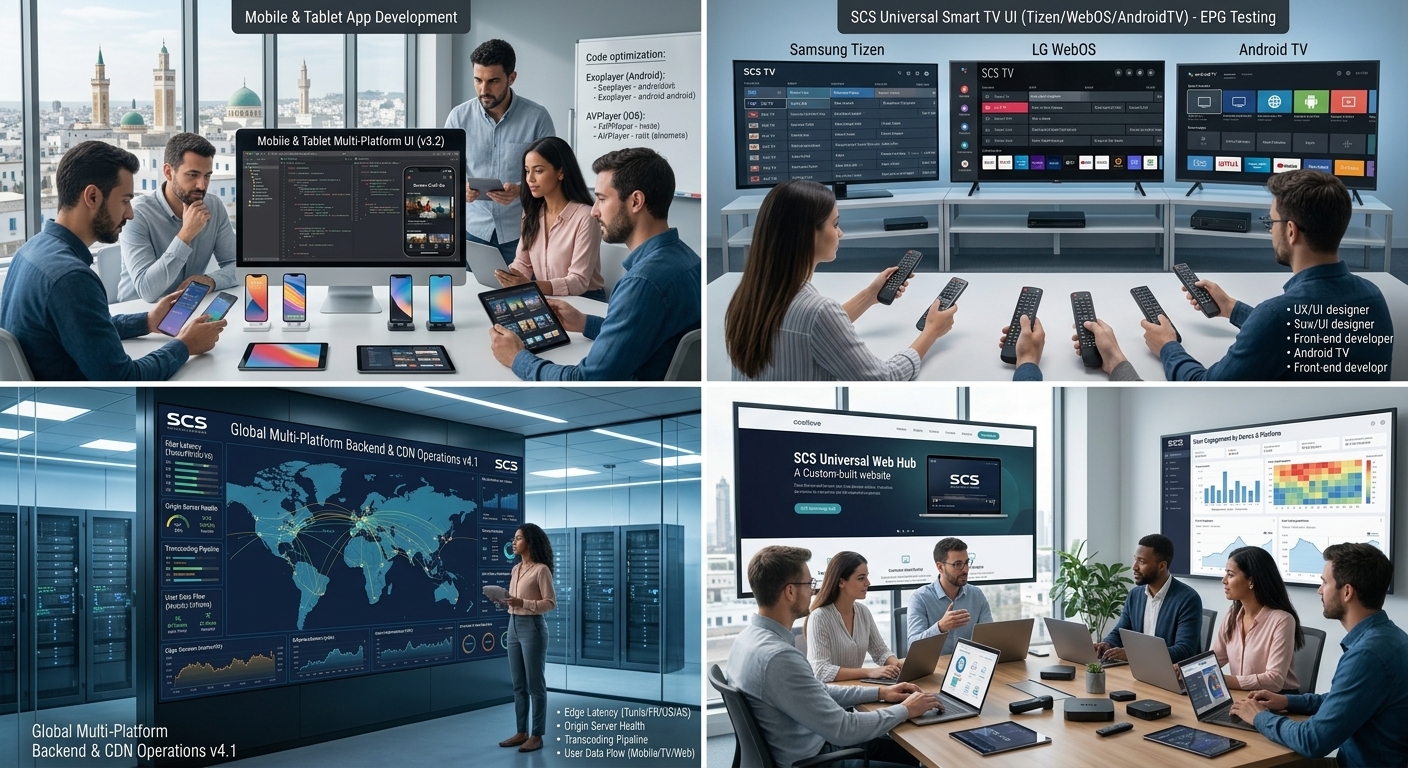
Streaming platform overview
Content, playback and delivery · Concept illustration
Who this is for
Technical approach
Design live or file-based transcoding workflows around source quality, target devices, rendition requirements and operating cost. Define the device or workflow boundaries and verify representative inputs before expanding the implementation.
Project capabilities
Inspect representative inputs, frame rates, interlacing, audio channels and caption formats before defining output profiles.
Balance quality and delivery cost with a measured bitrate ladder; align segment boundaries for reliable rendition switching.
Plan input recovery, processing capacity, latency expectations and failover ownership for continuous sources.
Implement idempotent jobs, progress tracking, retries and output validation before publishing an asset.
Record encoder health, processing time and output errors; choose CPU or GPU capacity using representative workload tests.
Project process
Agree on audience, supported devices or workflows, service ownership, media samples and measurable acceptance checks.
Document the operator or viewer journeys, backend contracts and failure behavior before implementation.
Validate a representative end-to-end journey with real integrations before completing the remaining capabilities.
Exercise agreed cases, document operating procedures and prepare release materials and maintenance responsibilities.
Questions
Share target devices or delivery specifications, example content, API documentation, account requirements and launch constraints. We use these to define a testable first release.
Yes, where documented interfaces and the required permissions are available. Discovery establishes data ownership, authentication, rate limits and failure handling before committing to an integration.
No. Playback, DRM, media formats, store requirements and hardware performance vary. The supported matrix and acceptance criteria are agreed and tested for the specific project.
Explore the connected platform work and implementation notes.
Technical references
Share your target devices, product requirements and existing systems to scope the next step.