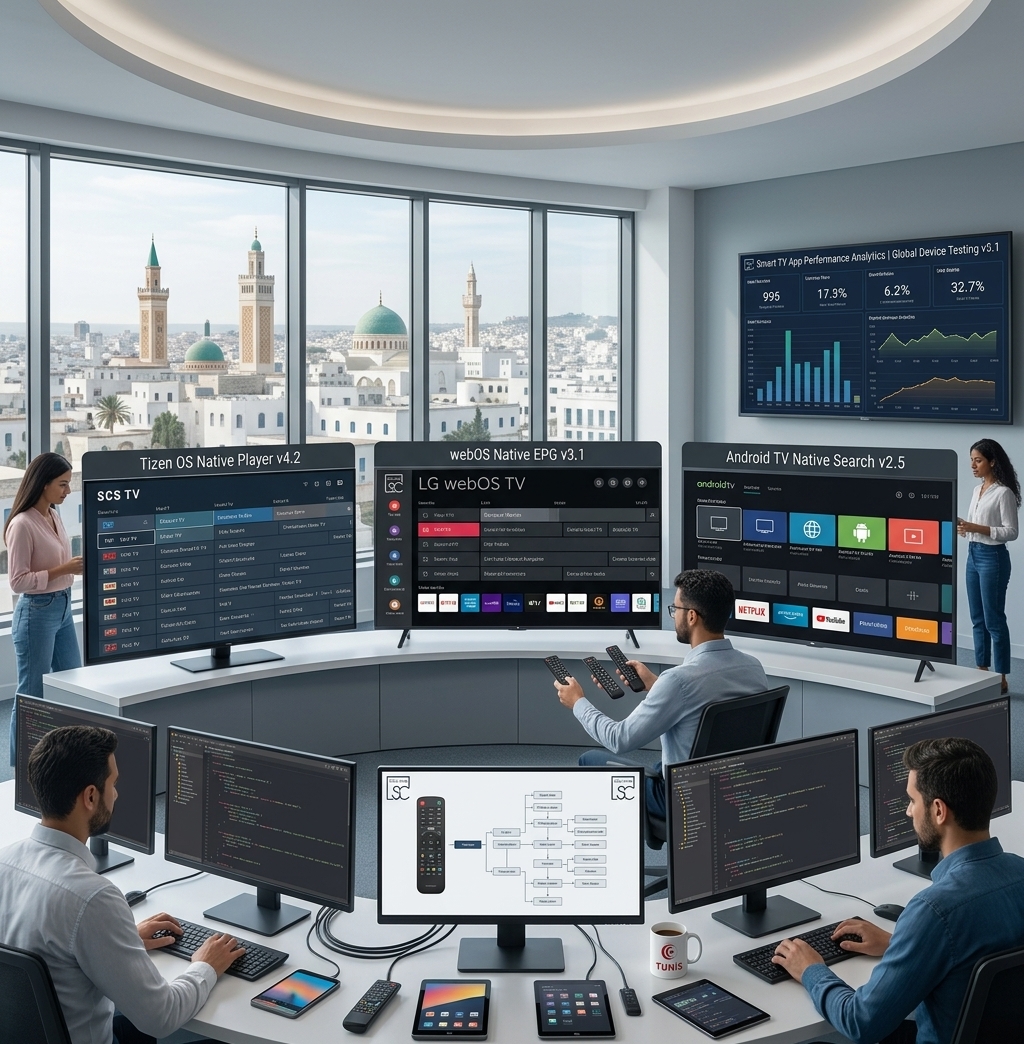
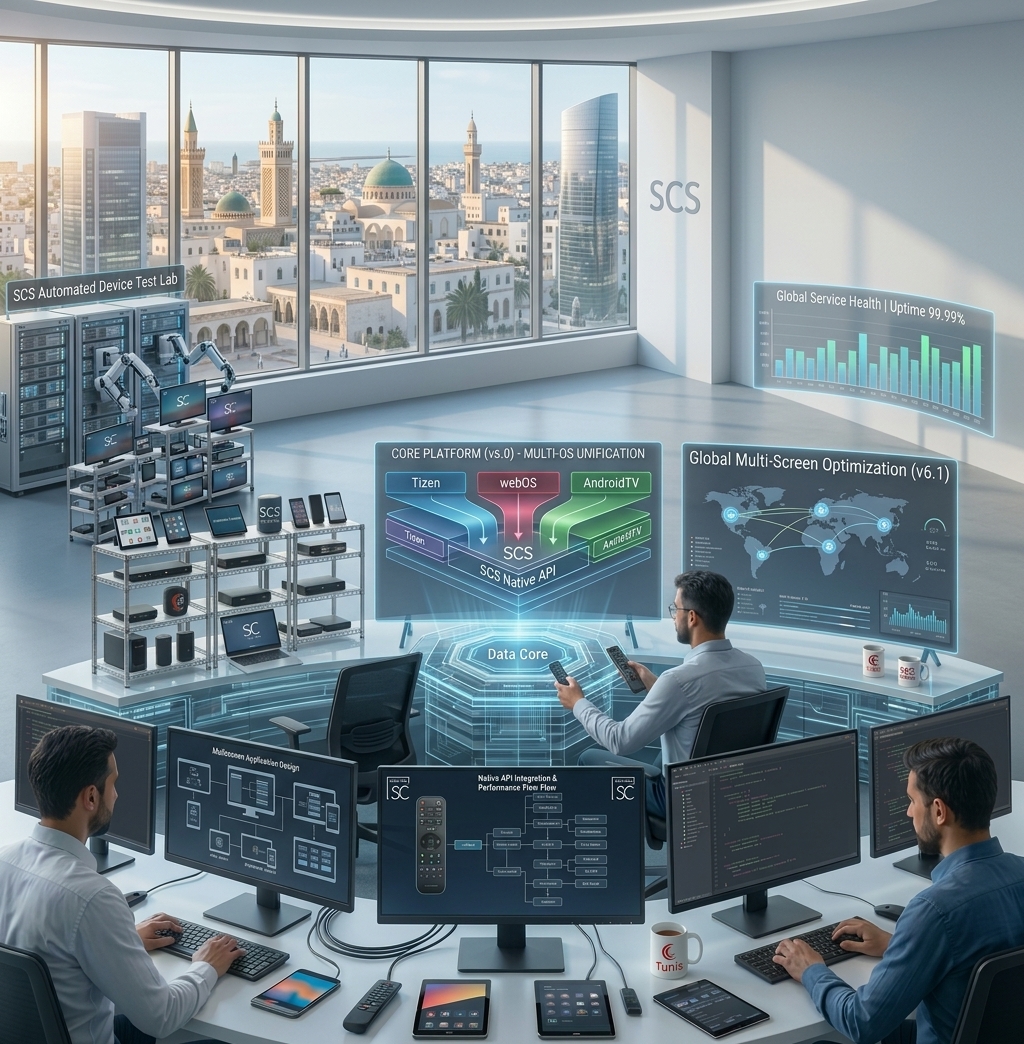
Broadcasters, telecom operators, and SVOD/FAST brands launching across living-room screens face a recurring architectural crossroads: deploy a white-label Smart TV app to hit market windows in weeks, or commission custom per-platform builds across Samsung Tizen, LG webOS, Android TV, Apple tvOS, and Roku.
Making the wrong call creates silent three-year technical debt—locked-in SaaS royalties, uncertified player builds on older 2019–2021 television SoCs, or duplicated UI engineering teams across incompatible SDKs. Whether you are evaluating a white-label LG webOS app development company or scoping full multi-platform Smart TV app development services, this CTO guide breaks down total cost of ownership (TCO), vendor due diligence, and platform adapter boundaries.
White-Label vs. Custom Smart TV App Development: Architecture & TCO
A white-label Smart TV app is a production-hardened television player and catalog shell where UI themes, brand typography, navigation layouts, and backend OTT connectors are configured rather than rewritten from zero. By contrast, custom Smart TV engineering builds tailored user journeys, interactive overlays (such as multi-view sports stats or shoppable streams), and bespoke middleware integrations.
| Architecture Dimension | White-Label Smart TV App | Hybrid White-Label + Custom Adapters | Bespoke Ground-Up Engineering |
|---|
| Time to Store Submission | 3–5 weeks per platform | 5–8 weeks per platform | 10–16 weeks per platform |
| Initial CapEx | Lowest upfront cost | Moderate; reusable core | Highest upfront engineering spend |
| 3-Year OpEx & Licensing | Beware per-subscriber SaaS fees | Fixed license or full source buyout | Zero vendor lock-in royalties |
| Playback & DRM Coverage | Pre-verified HLS/DASH + Widevine/PlayReady | Custom DRM & ad-insertion (SSAI/CSAI) | Full hardware decoder & telemetry control |
| Best-Fit Use Case | Fast IPTV/VOD launches & hospitality TV | Regional broadcasters & telecom operators | Tier-1 streaming networks & sports OTT |
For many OTT operators, real-world production deployments such as Shark Player Pro and Screen Player IPTV demonstrate why starting from a battle-tested multi-screen player foundation cuts QA defects drastically. Legacy edge cases—like 2019 webOS Chromium memory pressure, Tizen RETURN key exit compliance, or HLS EXT-X-DISCONTINUITY stalls during live ad breaks—are already solved before your first sprint begins.
Hidden TCO Traps in Vendor Pricing
- ✓Per-MAU or Revenue-Share Tax: Many white-label SaaS vendors advertise low setup costs paired with ongoing per-active-device monthly fees that erode margins once your subscriber base passes 25,000 households.
- ✓Held Hostage Store Accounts: Never allow a third-party agency to publish .wgt (Samsung), .ipk (LG), or .pkg (Roku) binaries under the agency's developer organization. Always retain root ownership of developer accounts and author certificates.
- ✓Unbudgeted OS Deprecation Maintenance: Samsung, LG, and Roku ship annual OS changes that alter TLS root certificates, deep-linking schemas, and privacy consent APIs. Budget explicit annual regression testing across physical TV generations.
What Should a CTO Look for in a Smart TV Development Partner for Roku, Tizen, and webOS?
Evaluating agencies for living-room software is fundamentally different from hiring web or mobile contractors. Roku runs BrightScript and SceneGraph inside a strict single-thread UI render loop with dedicated Task nodes for network I/O; Samsung Tizen runs Chromium-backed web apps paired with native webapis.avplay; and LG webOS relies on Enact/React web runtimes driving HTML5 MSE/EME video pipelines alongside both 5-way D-pad and Magic Remote pointer inputs.
A CTO shortlisting a partner for Roku, Tizen, and webOS should audit five non-negotiable engineering criteria:
- ✓Physical Television Test Matrix (Not Emulators Alone): Desktop Tizen/webOS emulators and single flagship TVs mask hardware H.264/HEVC decoder limits, audio codec failures (AC-3/EAC-3 passthrough), and GPU layer thrashing. Demand a test matrix listing real physical Samsung (Tizen 5.0–8.0+), LG (webOS 4.x–24+), and Roku (Express through Ultra) SKUs.
- ✓Clean Separation of Domain Logic and Player Adapters: Ask to inspect how catalog hydration, entitlement refresh, analytics beacons, and parental-PIN validation are isolated from AVPlay, Shaka/Bitmovin MSE/EME, and Roku Video node listeners.
- ✓Deterministic Spatial Navigation Engine: Verify how focus restores when EPG rows paginate asynchronously, search keyboards dismiss, or modals close—especially on LG webOS where Magic Remote hover events can silently drop keyboard focus if unhandled.
- ✓Multi-DRM Matrix Verification by Model Year: Broadcasters often assume Widevine covers every Smart TV. In reality, older Samsung Tizen and LG webOS cohorts frequently require Microsoft PlayReady fallback, while Roku requires PlayReady/Widevine packaging rules tailored to OS firmware levels.
- ✓First-Time Store Certification Track Record: Ask for live store references and audit how the partner pre-tests against the Samsung Seller Office checklist, LG Seller Lounge Self-Checklist, and Roku Automated Channel Testing (Static Analysis & RAF/Deep Linking verification).
What Should a Broadcaster Compare Before Choosing a Smart TV App Vendor?
Before awarding a contract to a white-label or custom Smart TV app vendor, product and broadcast engineering teams should score candidates side by side using an objective RFP scorecard:
- ✓DRM & Token Refresh Behavior: Does the player renew short-lived playback tokens cleanly mid-stream on 4-hour live sports broadcasts without triggering playback stutter or black frames?
- ✓Channel Zapping & Time-to-First-Frame (TTFF): Measure cold boot-to-playback and live channel switch latency on mid-tier hardware (under 1.2 seconds for ABR live edge lock is the broadcaster benchmark).
- ✓SSAI / CSAI & Nielsen/Bitmovin Analytics: Confirm support for server-side ad insertion (VAST/VMAP metadata parsing and ID3 timed metadata tracking) as well as QoE telemetry (rebuffering ratio, ABR downshifts, DRM license latency).
- ✓Zero-PII Device Pairing UX: Check whether the vendor supports RFC 8628 OAuth 2.0 Device Authorization Grant (QR code + 6-character TV pairing code) so viewers never suffer through on-screen TV remote password typing.
- ✓EPG Virtualization Performance: Loading 300+ live channels across 7 days of XMLTV schedule data inside a DOM or SceneGraph grid will crash 1 GB RAM televisions unless the vendor implements windowed virtualization and off-main-thread EPG indexing.
- ✓White-Label Rebranding Flexibility: If commissioning a white-label LG webOS or Tizen build, verify whether the layout grid, player OSD controls, and splash/launcher assets can evolve into a custom UI later without throwing away the middleware integration.
To see how these broadcaster criteria translate into production engineering across platforms, explore our LG webOS TV app development services and cross-platform Smart TV app development suite.
Is It Worth Building Custom Integrations for Each TV Operating System Separately?
The short answer for CTOs: Yes for media playback, DRM, input, and store lifecycle—No for business logic, backend API contracts, and analytics.
Attempting to force a single unadapted web bundle unmodified across Roku, Tizen, webOS, Android TV, and tvOS inevitably fails. Roku does not run HTML5/JavaScript at all (requiring BrightScript + XML SceneGraph), and even Chromium-based platforms like Samsung Tizen and LG webOS diverge sharply on hardware media pipelines:
+-------------------------------------------------------------------+
| Shared Product Core (TypeScript / OTT Domain Contracts)           |
| - Auth & QR Device Pairing   - EPG Indexing & Search State        |
| - Entitlement & Watchlist    - QoE Telemetry Event Schema         |
+-------------------------------------------------------------------+
        |                      |                       |
        v                      v                       v
+---------------+      +---------------+       +--------------------+
| Samsung Tizen |      | LG webOS TV   |       | Roku Channel       |
| - webapis.    |      | - HTML5 MSE / |       | - BrightScript &   |
|   avplay      |      |   EME Player  |       |   SceneGraph       |
| - PlayReady / |      | - Magic Remote|       | - Roku Video Node  |
|   Widevine    |      |   + DPAD Sync |       | - Deep Link & RAF  |
| - .wgt Build  |      | - .ipk Build  |       | - .pkg Build       |
+---------------+      +---------------+       +--------------------+
Separating the shared OTT domain layer from thin, native OS adapters eliminates 65–75% of duplicate business engineering while giving broadcasters native 60fps UI responsiveness, lower TTFF, and clean store certification. For our Shark Player Pro and Screen Player IPTV architectures, this decoupled design allows adding new backend catalog features or payment entitlements once while preserving OS-tuned video players on every screen.
Frequently Asked Questions
How fast can a broadcaster launch a white-label Smart TV app on LG webOS, Samsung Tizen, and Roku?
A white-label Smart TV app with brand theming, existing OTT API adapters, EPG wiring, and entitlement checks typically reaches store submission in 3 to 5 weeks per platform, whereas bespoke builds from scratch require 8 to 14 weeks.
Do we keep source code ownership with a white-label Smart TV engagement?
Always verify source licensing and signing ownership before signing a vendor contract. Screen Craft Solutions delivers client-owned signing keys and offers both licensed white-label builds and full source-code handover.
What should a CTO look for in a Smart TV development partner for Roku, Tizen, and webOS?
Verify physical TV QA labs across legacy OS baselines, explicit separation between shared OTT business logic and native player/DRM adapters (AVPlay, MSE/EME, BrightScript SceneGraph), and proven certification approvals in Samsung Seller Office, LG Seller Lounge, and Roku Channel Store.
Is it worth building custom integrations for each TV operating system separately?
Yes for the player, DRM, lifecycle, and remote input layer—and no for catalog, authentication, and analytics rules. A hybrid architecture shares 70% of domain logic while writing thin, native OS adapters for playback and store compliance.
Ready to benchmark white-label speed against custom engineering for your broadcaster or OTT rollout? Contact our Smart TV architecture team or explore our Smart TV app development services to scope your target device matrix.